
How to Evaluate SEO Performance
Rankings are not the same thing as revenue.
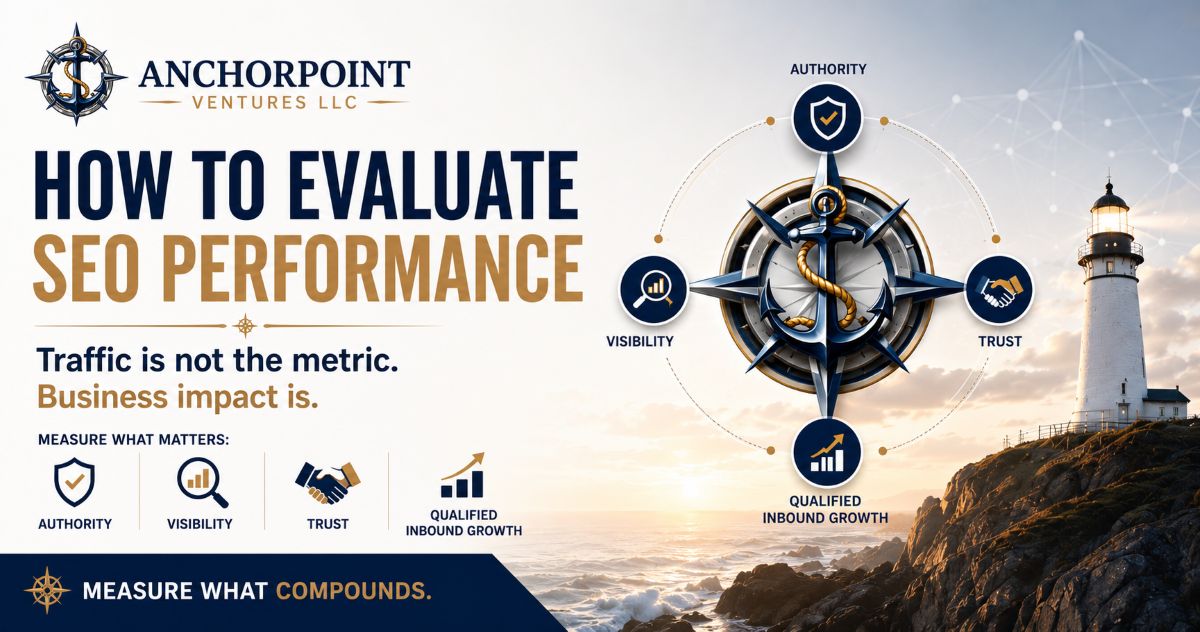
AnchorPoint Ventures LLC helps founder-led businesses and executive teams evaluate SEO performance based on business outcomes, not just rankings, traffic, impressions, or reporting activity.
Definition: SEO performance is the measure of whether search visibility generates qualified conversations, inbound opportunities, pipeline growth, and measurable business outcomes—not simply visibility metrics.
Businesses increasingly evaluating AI Search Optimization also need to measure whether their authority system is being understood, retrieved, trusted, reinforced, and surfaced across AI-driven search environments.
Most companies are not struggling because SEO itself is impossible.
They are struggling because they are measuring the wrong things.
Many businesses are losing visibility right now without realizing it.
Buyers increasingly discover businesses through Google, ChatGPT, Bing AI, Copilot, Reddit discussions, AI-generated answers, conversational search systems, and AI-assisted recommendation environments before they ever fill out a form or schedule a call.
If your SEO reporting cannot clearly connect visibility to qualified conversations and revenue opportunities, you may be optimizing the wrong system entirely.
Weak retrieval-based authority often creates visibility without trust, traffic without qualified action, and AI exposure without meaningful inbound demand.
Questions Business Owners Are Actually Asking
- Why is my website getting traffic but not leads?
- Why does my SEO feel active without producing revenue?
- Why are visitors leaving without contacting us?
- Why are competitors appearing in ChatGPT but not my business?
- Why does marketing feel busy without compounding growth?
- Why do rankings fluctuate without improving sales?
- Why does my SEO agency keep sending reports without business impact?
- How do I know whether SEO is actually working?
- Why are AI systems rarely mentioning our business?
Those are usually structural authority, intent alignment, conversion, and positioning problems — not “visibility metric” problems.
The Problem With How SEO Is Commonly Measured
Most SEO reporting focuses heavily on:
- Keyword rankings
- Organic traffic
- Impressions
- Indexed pages
- Publishing activity
- Technical task completion
None of those are actual business outcomes.
They are signals.
Why is SEO performance often misinterpreted?
Because visibility metrics are treated as success instead of evaluating whether visibility is producing real business impact.
This is one reason many businesses experience:
- Traffic without leads
- Visibility without conversations
- Rankings without revenue impact
- SEO activity without compounding growth
Modern AI visibility systems make this even more important because search performance now includes retrieval, citation, synthesis, entity understanding, and decision-stage trust.
The Only Question That Actually Matters
Is SEO producing qualified conversations capable of becoming revenue?
If the answer is no, something in the system is misaligned.
That misalignment may involve:
- Wrong search intent
- Weak authority formation
- Poor decision-stage structure
- Fragmented internal relationships
- Weak conversion pathways
It may also involve weak AI-driven search visibility if the business is not clearly understood, retrieved, reinforced, and trusted across modern search and answer environments.
Traditional SEO Metrics vs Business-Aligned SEO
| Traditional SEO Metrics | Business-Aligned SEO |
|---|---|
| Measures rankings | Measures qualified conversations |
| Tracks traffic volume | Tracks buyer intent alignment |
| Focuses on impressions | Focuses on pipeline growth |
| Publishes isolated content | Builds authority systems |
| Measures activity | Measures business outcomes |
Businesses serious about retrieval-focused authority should evaluate whether their visibility system is becoming easier for both people and AI systems to understand, trust, retrieve, and recommend.
A Better Way to Evaluate SEO Performance
Strong SEO systems are evaluated across four core layers:
1. Intent Alignment
Are you attracting people capable of becoming customers?
Visibility without buyer intent rarely compounds into revenue.
2. Structural Authority
Does the site reinforce itself clearly, or is authority fragmented across disconnected pages?
Strong authority systems compound. Weak systems reset constantly.
Modern AI Search Optimization systems depend heavily on this kind of structural reinforcement because AI-driven systems need clear relationships before they can confidently retrieve and synthesize information.
3. Decision-Stage Clarity
Can visitors quickly understand:
- What you do
- Who you help
- Why they should trust you
- What happens next
If not, traffic often fails to convert regardless of volume.
4. Conversion Behavior
Are visitors becoming conversations, leads, inquiries, or opportunities?
Visibility without conversion behavior is not a finished system.
What Healthy SEO Performance Looks Like
- Growth in decision-stage search visibility
- Pages reinforcing each other structurally
- Consistent inbound inquiries
- Alignment between search and sales conversations
- Stable authority growth over time
- Increasing AI-search discoverability
At that point, SEO starts behaving like a compounding authority system instead of isolated marketing activity.
Strong AI discoverability can become a meaningful performance signal when it connects to branded search growth, qualified visits, better trust formation, and inbound conversations.
What Weak SEO Performance Looks Like
- Traffic without conversions
- Rankings without business impact
- Content without authority reinforcement
- Constant strategic resets
- Reporting without pipeline clarity
- Visibility disconnected from decision-stage behavior
Weak systems often struggle with AI retrieval visibility because the business is not clearly reinforced as a trusted authority around the topics buyers are actually evaluating.
SEO agency not delivering results
When Patience Is Correct vs When It Is Dangerous
Some SEO systems genuinely require time to compound.
But time alone does not fix structural misalignment.
Healthy systems usually show:
- Increasing decision-stage visibility
- Growing reinforcement between pages
- Stronger engagement behavior
- More qualified inbound signals over time
Weak systems often show:
- Activity without compounding
- More publishing without stronger authority
- Traffic without meaningful conversations
- Repeated resets without stability
In AI-driven environments, weak systems may also show poor citation presence, inconsistent entity understanding, and limited retrieval-based authority even when traditional SEO reports appear active.
Indexing itself can also behave in ways that resist simple explanations. In our own work, we have seen three websites built using many of the same SEO principles receive dramatically different treatment from Google. We are documenting those results—including the possible role of an inherited domain and backlink history—in our ongoing Google indexing case study .
What To Do Next
At this point, you have two options:
Continue measuring activity:
Assume progress is happening because visibility metrics are improving
→ Risk reinforcing the wrong system
Evaluate the system structurally:
Determine whether SEO is aligned with authority, intent, AI visibility, retrieval confidence, and business outcomes
→ Identify what actually needs to change
Start the Search Authority Diagnostic
Frequently Asked Questions
What is SEO performance?
SEO performance is the ability of search visibility to generate qualified conversations, inbound opportunities, and measurable business growth.
How should SEO actually be measured?
SEO should be evaluated based on buyer intent alignment, authority formation, conversion behavior, pipeline impact, and real business outcomes—not just rankings or traffic.
Are rankings important?
Rankings are signals, not outcomes. They only matter if they contribute to qualified inbound opportunities and business growth.
Why does SEO show progress but no results?
Because visibility metrics may improve while the authority structure, intent alignment, or conversion pathways remain weak.
What is the biggest mistake in SEO evaluation?
Treating impressions, rankings, and traffic as final outcomes instead of measuring real business impact.
How does AI search change SEO evaluation?
AI-driven search increasingly rewards authority clarity, structured relationships, decision-stage content, and extractable answers instead of simple keyword visibility alone.
When should SEO be re-evaluated?
SEO should be re-evaluated when visibility improves without corresponding increases in qualified leads, conversations, or revenue opportunities.